
Reflections from our 2026 November Community of Practice session 🤓
Nov 10, 2026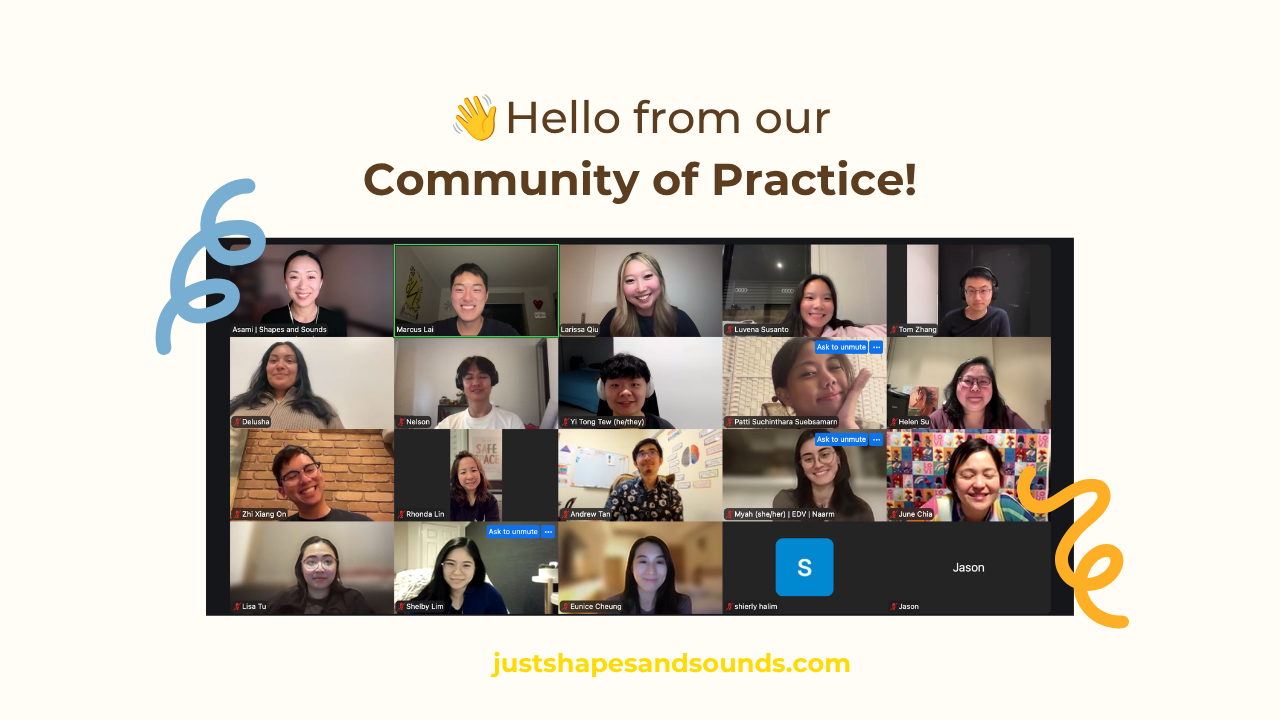
At Shapes and Sounds we acknowledge the importance of accessing up-to-date scientific evidence in the delivery of evidence-based mental health care. As such, we bring together Asian mental health practitioners each quarter in our Community of Practice (formerly Connect and Grow) - a professional development program where we collaboratively reflect and discuss the practical relevance of recent literature surrounding the mental health of Asian populations within Australia.
What did we discuss in our session?
We were honoured to invite provisional psychologist and PhD (Clinical Psychology) candidate Larissa Qiu from Monash University to share her doctoral research on how cultural factors influence wellbeing.
In this session, we discussed her systematic review Exploring Cultural Influences in the Associations Between Emotion Regulation and Mental Health: A Systematic Review Comparing East Asian and Western Cultural Contexts. This review was an important reminder of how cross-culturally, the role of different emotion regulation strategies may play different roles for psychological wellbeing. Importantly, many within-culture nuances were also highlighted with Larissa's review, with some of the associations between emotion regulation and wellbeing varying across different types of emotions and cultural values (e.g., self construal) etc. Overall, these highlight how the role of emotion regulation can vary greatly depending on 1) cultural factors and 2) situational goals.
Key discussion themes and practitioner reflections
-
Larissa highlighted how although emotion regulation is a transdiagnostic construct (i.e., implicated across many different mental disorders), the role it plays can vary greatly across Western and East Asian cultures. Specifically, cultural differences in how one 1) perceives themselves, 2) embraces contradictions, 3) is oriented towards negative emotions, and 4) views hardships and adversities can shape how someone chooses to regulate their emotions, and the subsequent outcomes of those strategies.
- Many practitioners resonated with this idea. Many highlighted how emotional restraint is seen as more acceptable within Asian cultures, which can contrast Western contexts which sometimes value autonomy and outward emotional expression.
- However, some practitioners also reflected on how being Asian within a Western context (i.e., Australia) can influence emotion regulation. Some questions include: How might someone maintain a sense of autonomy but still remain connected to others within collectivistic cultures? Would the role of the therapist be to also encourage Asian clients to be more open about speaking up - especially within an Western context? What might it mean to stay emotionally connected, but not responsible, for others?
- These led practitioners to reflect on the importance of keeping an open mind when approaching conversations surrounding emotion regulation with clients, to remain aware of cultural influences but also be informed by the clients situational goals (i.e., meeting them where they are at and understanding their unique 'combination' of Western/Eastern cultures). That is, even if as Asian therapists, we are able to understand cultural stereotypes, these assumptions should not be imposed upon the client, and it should be up to the client to define how their unique cultural experiences shape emotion regulation.
- Practitioners related to this the importance of viewing formulation as dynamic. New information about how someone's unique cultural context influence emotion regulation should continually shape how therapists interpret someone's presentation.
- The lines between collectivism/individualism seem to be blurring, especially in a multicultural society like Australia. Practitioners highlighted the importance of moving beyond these dichotomies to acknowledge how every individual can encompass aspects of both, and that perhaps different aspects of collectivism/individualism can take priority depending on situational goals.
~
Shapes and Sounds is home to the largest Community of Practice for Asian mental health professionals in Australia and we meet quarterly to discuss papers as summarised above.
As an Asian therapist, your lived experience is powerful. However, it's not sustainable to rely purely on this to provide culturally-responsive care to the people you support. Our Community of Practice connects you with the latest emerging literature in Asian mental health to help you up-skill, stay relevant and maintain your CPD hours.
Stay tuned our on website here and our socials to receive updates on our Community of Practice sessions for 2027.
Alternatively, if you're interested in connecting with Shapes and Sounds through our cultural-competency trainings, you can learn more about our trainings here.
💡For community members:
We created the "Essential Guide for Asian Australian Mental Health" by surveying over 350 Asian Australians during Covid-19 lockdowns.
Download our guide and learn about the three most pertinent areas of concern for the Asian community, with tips and strategies to support you through.
🤝For mental health service providers:
Shapes and Sounds supports mental health organisations and teams to feel confident and resourced in providing culturally-responsive care to the Asian community in Australia.
Download our information pack to learn more.