
Reflections from our August Community of Practice session
Aug 08, 2026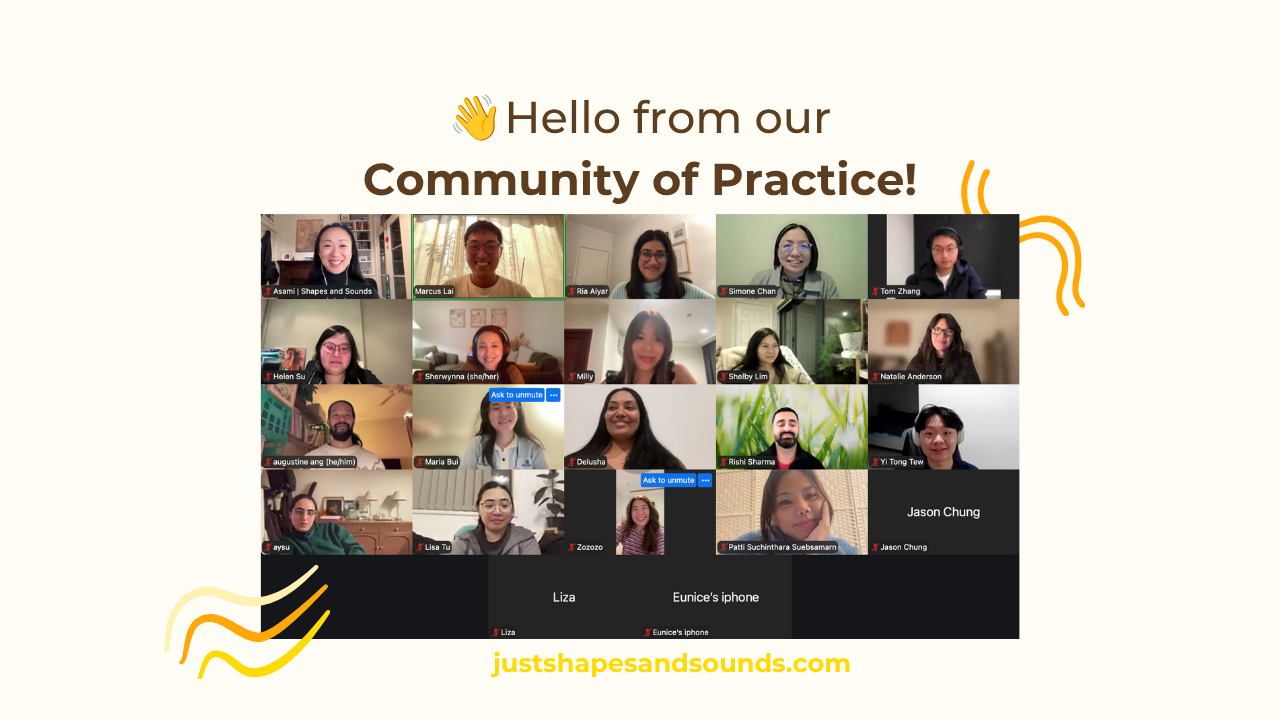
At Shapes and Sounds we acknowledge the importance of accessing up-to-date scientific evidence in the delivery of evidence-based mental health care. As such, we bring together Asian mental health practitioners each quarter in our Community of Practice (formerly Connect and Grow) - a professional development program where we collaboratively reflect and discuss the practical relevance of recent literature surrounding the mental health of Asian populations within Australia.
What did we discuss in our session?
We were honoured to invite Dr Ria Aiyar who recently completed her PhD in Psychology from the University of Adelaide. Her doctoral research explored the migration and wellbeing experiences of South/South East Asian families across pregnancy and early childhood.
For the session, we discussed one of Ria's qualitative studies, titled Parenting experiences and impacts to wellbeing for South and Southeast Asian migrant caregivers in Australia across the First 2000 Days: reflections from migrants and service providers. Ria's research not only humanises the migrant experience and spotlights the many barriers and challenges which migrant's face, but more importantly, also highlights the innate strength and resilience which many display.
Key discussion themes and practitioner reflections
-
Ria reflected on two key concepts which drove her study.
- Wellbeing as a positive state - An overwhelming majority of studies on migrant wellbeing is centred around a deficit discourse, which solely highlights the risk factors associated with deteriorations in wellbeing. While this is important both theoretically and practically, it is also crucial to bolster the strengths and positive aspects of migrant health.
- Cultural specificity of traditional models of attachment - Our understanding 'secure' attachment is heavily rooted within socialisation norms and expectations set within Western contexts. These traditional frameworks on attachment are also often based on assumptions that all cultures have the same social goals and same resources to support their children. This neglects the unique, culturally-affirming ways of promoting social wellbeing which have supported diverse communities for centuries.
- Many practitioners agreed with these two concepts. Specifically relating to point 2, many mentioned how secure attachment may not have looked like outward emotional expression in their own Asian cultures, but may instead look like knowing you have family who will show up in an emergency, or having fruit cut for you.
- When reflecting on collectivistic vs individualistic parenting, practitioners acknowledged that there both positives and negatives to both. For example, while collectivism can provide us with robust support systems, it can also lead to social pressures and silencing of harms.
- Ria and the practitioners also reflected on the importance of incorporating "soft entry points" into models of mental health care for migrants. As many reflected on difficulties in service access and an underlying lack of trust for the system, soft entry points such as community based workers or supported play groups may help ease parents and families into support services.
- More broadly, practitioners reflected on what it means to provide culturally responsive care. Some points that were mentioned include:
- centring lived experience (in both research and practice)
- curiosity, ongoing learning, and a genuine appreciation of cultural strengths
- having an open mind and asking what people need in order to truly meet them where they are at
- not discounting other modalities of healing, to not view western biomedical model as "gold standard" of care
- to reflect and be aware of clinician's own power/authority as a practitioner
- providing clients with information (not advice) so that they can make informed choices
- in community mental health settings, power may look like using practitioner's own authority to advocate for client's needs, to seek the best information and feed that back to client
- using clinician's own understanding and lived experience of cultural context to better resonate and understand client, so that all spoken and unspoken needs are met and explored.
~
Shapes and Sounds is home to the largest Community of Practice for Asian mental health professionals in Australia and we meet quarterly to discuss papers as summarised above.
As an Asian therapist, your lived experience is powerful. However, it's not sustainable to rely purely on this to provide culturally-responsive care to the people you support. Our Community of Practice connects you with the latest emerging literature in Asian mental health to help you up-skill, stay relevant and maintain your CPD hours.
Stay tuned our on website here and our socials to receive updates on our Community of Practice sessions for 2026.
Alternatively, if you're interested in connecting with Shapes and Sounds through our cultural-competency trainings, you can learn more about our trainings here.
💡For community members:
We created the "Essential Guide for Asian Australian Mental Health" by surveying over 350 Asian Australians during Covid-19 lockdowns.
Download our guide and learn about the three most pertinent areas of concern for the Asian community, with tips and strategies to support you through.
🤝For mental health service providers:
Shapes and Sounds supports mental health organisations and teams to feel confident and resourced in providing culturally-responsive care to the Asian community in Australia.
Download our information pack to learn more.