
"I Cried for Two Hours Before Coming Out": Malaysian Psychologist Dr. On on Identity, Shame, and Finding Safety in Melbourne
Jul 21, 2026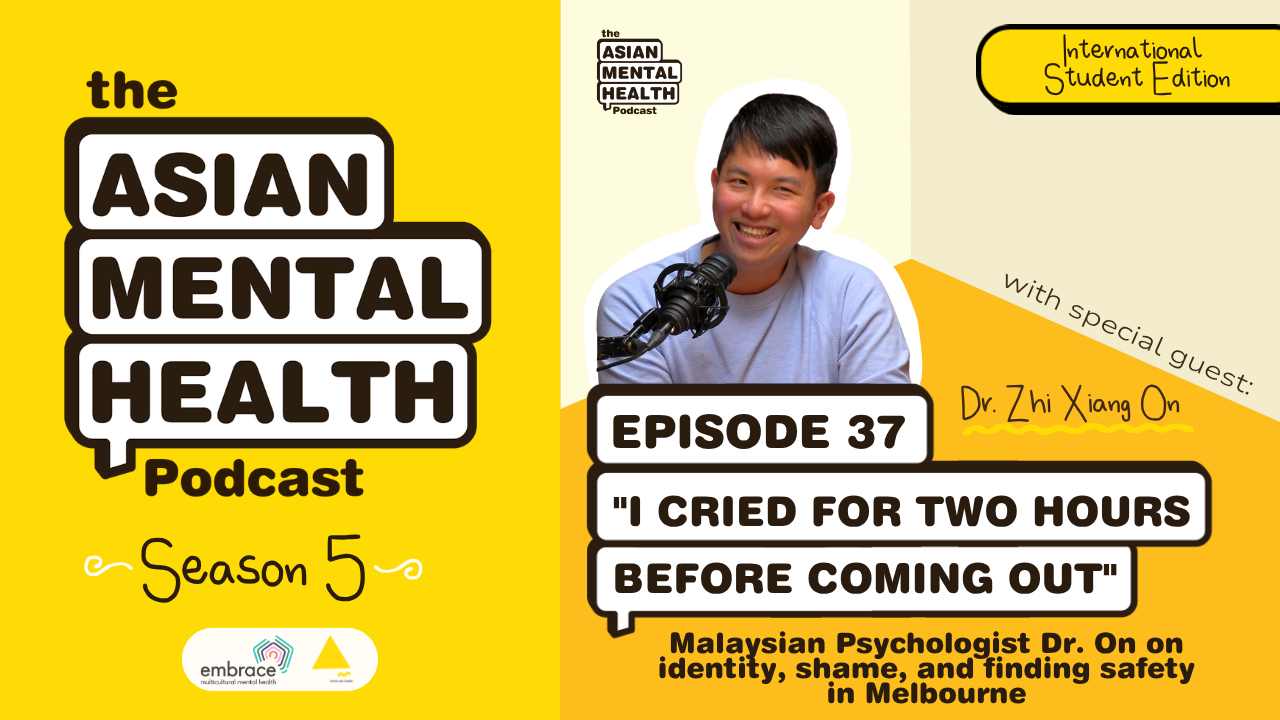
What does it take to move to a new country at 19, navigate culture shock, come out as gay while studying psychology, work through perfectionism and shame, and eventually build your own clinical practice? In this episode, Dr. Zhi Xiang On takes us on that journey with warmth, humour, and remarkable honesty.
On moved from Klang, Malaysia to Melbourne to study psychology at 19. What started as curiosity about a big city quickly became a complex navigation of identity, belonging, and self-discovery. From not understanding why everyone walked so much, to learning that "Asian Australian" was a thing, to spending two hours crying before coming out to a friend, to eventually becoming a clinical psychologist, forensic psychologist, and clinical neuropsychologist, On's story is both deeply personal and universally relatable.
In this conversation with Asami, On opens up about the pressures of college party culture when you come from a conservative family, the guarded way he first approached university counselling, the moment a professor pointed out what he wasn't ready to hear about his sexual identity, and how working through his own "parts" transformed not just his studies but his entire approach to being a therapist.
This episode is for anyone who's ever felt like they had to perform being okay, anyone navigating identity while far from home, and anyone wondering what it really means to "work on yourself."
Watch the episode below or find us on Spotify or Apple Podcasts!
🎧 You'll hear about:
✅ Moving from a small Malaysian town to Melbourne at 19 and experiencing culture shock
✅ The loneliness crisis facing international students today
✅ Coming out as gay to friends and family while studying abroad
✅ University counselling: the benefits, barriers, and what students need to know
✅ Understanding your "parts" and what it means to work on yourself
✅ How to support peers using the HEAR framework
💡 Episode Highlights:
- Culture shock: "Why is everyone walking 15-20 minutes? In Malaysia, we drive everywhere because of the weather"
- Discovering Asian Australians exist: "I felt so much shame. I was like, what do you mean you're from here?"
- College party culture: "I came from a conservative Chinese Malaysian family. I was never exposed to party life or drinking"
- First therapy session: "I was so guarded. There was a lot of impression management, I wanted to be the best client"
- Coming out: "I cried for two hours before I even told my friend, 'Babe, I need to tell you I'm gay.' She said, 'I've been waiting for you to let me know'"
- The loneliness epidemic: "As we have more social media and AI, people have more ways to connect, but the reality is we are feeling lonelier and lonelier"
- Understanding "parts": "There's a part of me that's overworking, a part that wants to have fun, and a vulnerable part that felt shame and fear of not being accepted"
🧠 Key Takeaways from Dr. On:
"Most people are hesitant to reach out for help, but most people are willing to help. When you do reach out, chances are the other person will be more than happy to help you."
"You know your family best, so you go with your process. If you're not ready to come out, that's so fine. Maybe it's not safe. Listen to your inner feelings and go with that."
"University counselling is probably the best first point to go to because it's free and it is private and confidential. It does not go on your academic transcript. You will not be discriminated."
"We all have different parts. Sometimes parts fight with each other. The overworking part fights with the fun part. That internal conflict is very normal for human beings."
"We carry a lot of intergenerational burden. Growing up, we hear 'don't bother them, don't be a burden.' It makes sense culturally why we try to contain and keep it to ourselves."
"If you put yourself in another person's shoes and think, 'If someone came to seek help from me, how would I feel?' Then switch back: could I be this person who seeks help from others?"
"Embrace and enjoy the process. Your current journey is a great journey. Don't shy away from the downtimes because they are there to teach us a lesson as well."
👤 About the Guest
Dr. Zhi Xiang On is a clinical psychologist, forensic psychologist, clinical neuropsychologist, and the director of Back On Track Psychology, a private practice in Melbourne. Originally from Klang, Malaysia, On moved to Australia at 19 to study psychology at the University of Melbourne. His work emphasises a collaborative, safe, values-guided therapeutic relationship.
On's clinical work includes forensic risk assessments, treatments for violence and sexual offending, victim support, supervision to clinicians, teaching, research, and independent medical examinations for the Transport Accident Commission. He is passionate about helping individuals understand their strengths and supporting them on their journey to lifelong wellbeing. On brings both lived experience as a former international student and clinical expertise to understanding how culture, identity, and belonging shape mental health.
🔗 Find Dr. On on the Shapes and Sounds Practitioner List here
🌐 Back On Track Psychology website
🛠️ Resources Mentioned:
University Support:
- University counselling services: Free, private, confidential, does not appear on academic transcripts
- Peer mentorship programs: Check your university's student support services
The HEAR Framework for Supporting Peers:
- H: Hear people out with empathy
- E: Empower them with suggestions of where to seek help
- A: Encourage them to take Action
- R: Regroup, check back in with them
Private Support:
- OSHC (Overseas Student Health Cover): Provides partial rebates for psychology sessions (pay upfront, then claim)
- Back On Track Psychology: Clinical, forensic, and neuropsychological services
Self-Care Practices:
- Journaling: Writing by hand provides more cognitive processing than typing
- Parts work: Understanding the different parts of yourself and their functions
- Setting check-in reminders: Create a two-week reminder to reassess how you're feeling
🙌 Connect with Shapes and Sounds
🎁 Free Resource: Download "International Students and Mental Health"
~
Do you work with international students? If so, you may be interested in learning more about the Student Changemakers program as well as downloading our project summary report HERE.
~
✨ If this episode resonated with you, please subscribe, rate, and review the Asian Mental Health Podcast on your favourite podcast app. It really helps other international students find these conversations. Share this episode with your friends, especially if you know or are an international student, because word of mouth helps destigmatise mental health in Asian communities. 💛
The Asian Mental Health Podcast is a production from Shapes and Sounds, made on the stolen lands of the Wurundjeri Woi-wurrung people of the Kulin Nation. This show is hosted by Asami Koike and Marcus Lai and produced by Yeo Choong. This season is brought to you by Embrace Multicultural Mental Health. All thoughts and ideas you hear are independently ours and our guests.
💡For community members:
We created the "Essential Guide for Asian Australian Mental Health" by surveying over 350 Asian Australians during Covid-19 lockdowns.
Download our guide and learn about the three most pertinent areas of concern for the Asian community, with tips and strategies to support you through.
🤝For mental health service providers:
Shapes and Sounds supports mental health organisations and teams to feel confident and resourced in providing culturally-responsive care to the Asian community in Australia.
Download our information pack to learn more.