
Reflections from our May Community of Practice 2026
May 12, 2026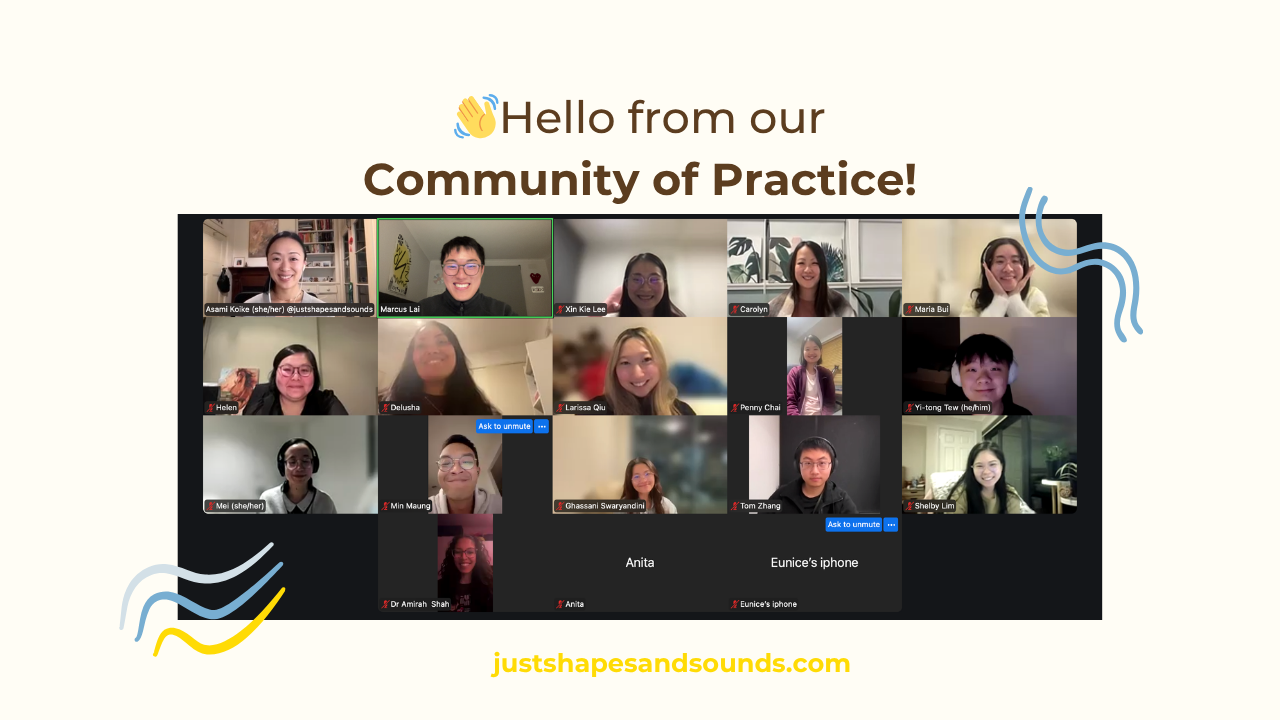
At Shapes and Sounds we acknowledge the importance of accessing up-to-date scientific evidence in the delivery of evidence-based mental health care. As such, we bring together Asian mental health practitioners each quarter in our Community of Practice (formerly Connect and Grow) - a professional development program where we collaboratively reflect and discuss the practical relevance of recent literature surrounding the mental health of Asian populations within Australia.
What did we discuss in our session?
We were honoured to invite Xinkie Lee, who is a research assistant from our research partner: the Culture, Trauma and Mental Health Research Group (Monash University), who discussed the cultural influences on coping following trauma exposure among Malaysian and European Australian individuals. Cross-cultural research has explored how individuals from different cultures may choose different coping strategies following trauma exposure (i.e., how people respond to trauma), but Xinkie's important research provided insights into the meanings which people make of their trauma responses, and how culture influences that process of meaning making (i.e., why people respond the way they do).
Exploring the meaning behind trauma responses is crucial. While two individuals may both demonstrate avoidance or withdrawal following trauma, one may be doing so due to feelings of overwhelm, but another may be doing so in order to protect others and not burden family/friends. Acknowledging these subtle differences in meaning can help clinicians make more appropriate responses to a client's coping strategy and provide true culturally-safe care.
Key discussion themes and practitioner reflections
-
Practitioners reflected on the necessity of identifying their own unconscious biases. Many discussed how their own personal views/previous training and education on what constitutes as an effective or adaptive coping strategy can inadvertently cloud their ability to maintain unconditional positive regard for clients whose responses differ from what is considered the "gold standard".
-
This highlighted the importance of remaining culturally curious and reflexive. Instead of jumping to label a behavior as "adaptive" or "maladaptive," practitioners were encouraged to probe the why, and understand that the same outward behavior can arise from different intentions. Practitioners were reminded that the adaptiveness and intentions of one's coping strategy are highly contingent on cultural factors. Shifting beyond the dichotomy of adaptive vs maladaptive can also help prevent creating shame and guilt within clients who exhibit coping strategies traditionally deemed "maladaptive" by Western literature.
-
By gently contextualising their own professional or cultural perspective (e.g., "In my cultural context, I might view this way of coping as...", "How does that compare to the meaning that this holds for you?"), clinicians can create a safer space for open dialogue and meaning making. In turn, by helping clients unpack their coping strategies within their specific sociocultural environment, this can help them gain greater clarity on the function of their behaviours and ensure a culturally-safe therapeutic journey. This "bigger picture" approach ensures that the support provided is congruent with the client's values, rather than being an interpretation imposed from the outside.
~
Shapes and Sounds is home to the largest Community of Practice for Asian mental health professionals in Australia and we meet quarterly to discuss papers as summarised above.
As an Asian therapist, your lived experience is powerful. However, it's not sustainable to rely purely on this to provide culturally-responsive care to the people you support. Our Community of Practice connects you with the latest emerging literature in Asian mental health to help you up-skill, stay relevant and maintain your CPD hours.
Stay tuned our on website here and our socials to receive updates on our Community of Practice sessions for 2026.
Alternatively, if you're interested in connecting with Shapes and Sounds through our cultural-competency trainings, you can learn more about our trainings here.
💡For community members:
We created the "Essential Guide for Asian Australian Mental Health" by surveying over 350 Asian Australians during Covid-19 lockdowns.
Download our guide and learn about the three most pertinent areas of concern for the Asian community, with tips and strategies to support you through.
🤝For mental health service providers:
Shapes and Sounds supports mental health organisations and teams to feel confident and resourced in providing culturally-responsive care to the Asian community in Australia.
Download our information pack to learn more.