
Meet Asian Australian Clinical Psychologist: Helen Su
May 01, 2026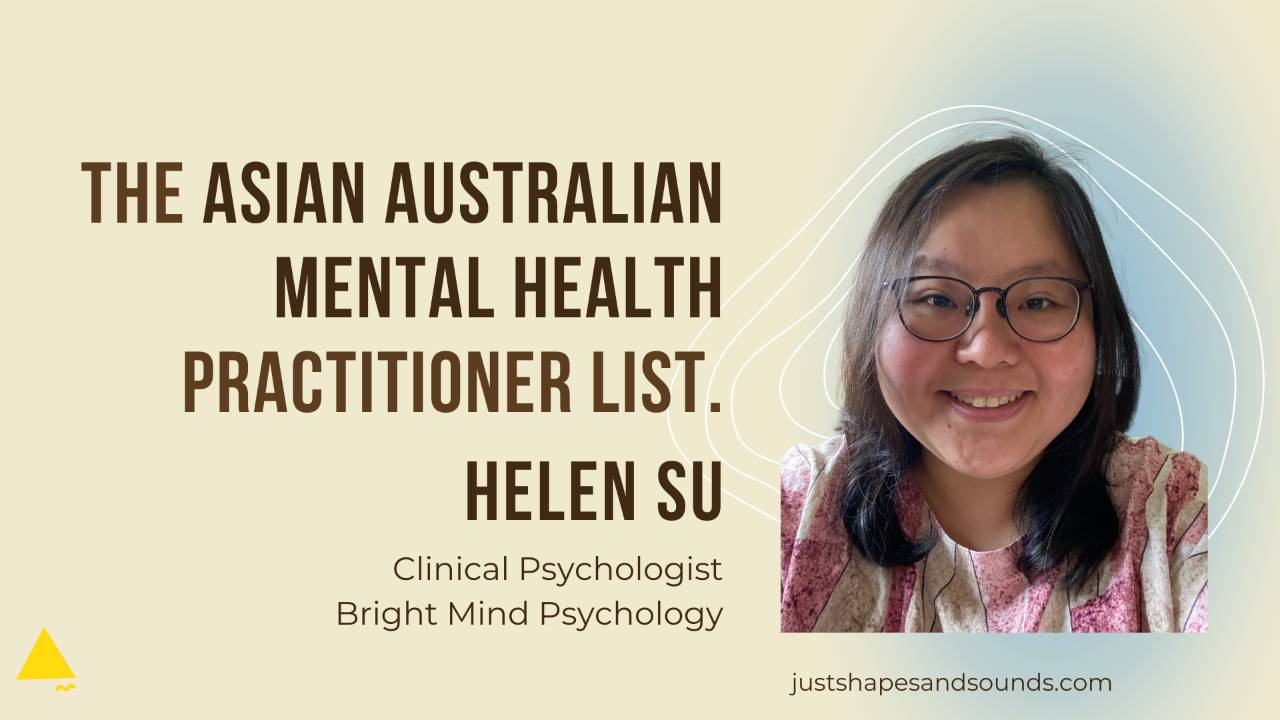
We know that it's not always easy trying to work out which therapist we might like to work with: Because the decision isn't just about where they're located and when they're available, but there's a bit more of a human, relational element to the decision too.
So here at Shapes and Sounds, we want to help make that process just a little easier.
Every month, we'll be introducing a therapist from the Asian Australian Mental Health Practitioner List to help you gain a bit more insight into who you feel might be a good fit for you or someone that you know.
This month we're excited to connect you with Helen who is a clinical psychologist offering services in Melbourne, VIC. We hope you enjoy connecting with Helen below!
~
1. What led you to choosing mental health as a career?
Fresh off the boat as an international student, I will always remember the sight of my first psychology teacher standing on a table - a curly-haired European-looking pregnant lady in her 30s greeted us as we walked into our first lecture. Behind her, PSYCHOLOGY written on the whiteboard.
I wish I could say I had some profound inclination that led me down this career path. Coming from Malaysia and having done poorly in a rigorous examination system, I knew what I was NOT interested in - becoming a doctor, lawyer or accountant. In my 17 year old mind, the lady standing on the table with matching wide-eyed teenage enthusiasm stood for the opposite. Thus my journey in psychology began as the product of the infectious passion Ms. Vincent brought as she introduced us to nature vs. nurture and the rest.
Over the years, being a psychologist has given me a front row seat to humanity. While having the privilege of meeting each client with their own unique story, it is their resilience and compassion that further strengthens my choice in career. I love watching as fellow human beings discover themselves and make purpose out of life amidst struggles. I am grateful that I get to be a part of that journey everyday.
2. What is your unique cultural heritage?
Post WWII, my family trace our roots back to a village at the border of Fujian and Guangdong provinces of China. War and famine saw both sets of grandparents making their way across the South China Sea by boat into Borneo - some with their families, others leaving loved ones behind. There, they found each other and my parents were born in and around the time Borneo was divided to form/join Brunei, Indonesia and Malaysia.
I grew up the first 17 years of my life in Sarawak (a part of Malaysia), in a fishing village turned regional city called Miri. I later came to Australia as an international student and have made this my second home of 23 years as of 2025. I proudly identify as a Chinese Malaysian Australian and more broadly as a global citizen.
3. What are your areas of specialty and what kind of frameworks do you work from?
Taking a client-centred approach, here are a few therapies I draw from to tailor to each clients' strengths:
My first love is acceptance and commitment therapy - the principles of psychological flexibility still underpin most of the work I do. Mindfulness of present moment and self-as-context, acceptance, cognitive defusion, values discovery and committed action are all still incorporated into the longer term work I do with clients.
Schema therapy is my therapeutic modality of choice. It works well for client seeking more in-depth longer term work and utilises various schools of thought and techniques - allowing a broader integration of skills. It is most helpful for those looking to challenge deep-seated patterns rooted in experiences from earlier years in life. It helps build a stronger self-concept in adulthood which enables individuals to fulfil their own emotional needs and form healthier relationships with themselves and others.
EMDR is another favourite that facilitates recovery by boosting the brain's own ability to process traumatic memories. Also particularly useful for phobias, anxiety and recent research demonstrating utility for other issues as well.
Other short-term approaches includes grief/bereavement counselling, interpersonal psychotherapy, and solution-focused therapy.
4. What kind of clients are you best able to support?
Clients who have gravitated towards my service are generally of diverse populations - most are second generation Asian Australians, international students and fellow first generation migrants etc. Goals typically involve achieving worklife balance, adjusting to parenting and making life in Australia, managing stress at the workplace or university. Most if not all with underlying trauma, depression or anxiety, family of origin challenges, neurodivergence, identity development and or/acculturation in the background.
I provide service to individual and adult clients who are typically busy, and looking for flexible, convenience via telehealth.
5. If you could be your own therapist right now, what do you think you would say to yourself?
Always check in with my inner child and to honour her needs so that my adult self finds a calmer and balanced way to be.
~
Connect with Helen via our Asian Australian Mental Health Practitioner List HERE.
Alternatively, if you feel like Helen may be a good fit for someone that you know, be sure to forward this page on to them too. Let us continue to not only support ourselves but all those around us too!
If you require urgent assistance, please do not contact Helen or any of the practitioners on this list. Instead, please call emergency services on 000 or call Lifeline on 13 11 14.
Shapes and Sounds does not recommend or endorse Helen or any of the practitioners listed on the Asian Australian Mental Health Practitioner List.
Please always consult your GP before making changes to your mental health care plan.
💡For community members:
We created the "Essential Guide for Asian Australian Mental Health" by surveying over 350 Asian Australians during Covid-19 lockdowns.
Download our guide and learn about the three most pertinent areas of concern for the Asian community, with tips and strategies to support you through.
🤝For mental health service providers:
Shapes and Sounds supports mental health organisations and teams to feel confident and resourced in providing culturally-responsive care to the Asian community in Australia.
Download our information pack to learn more.