
Meet Asian Australian Registered Psychologist, Claire Qiu
Oct 01, 2026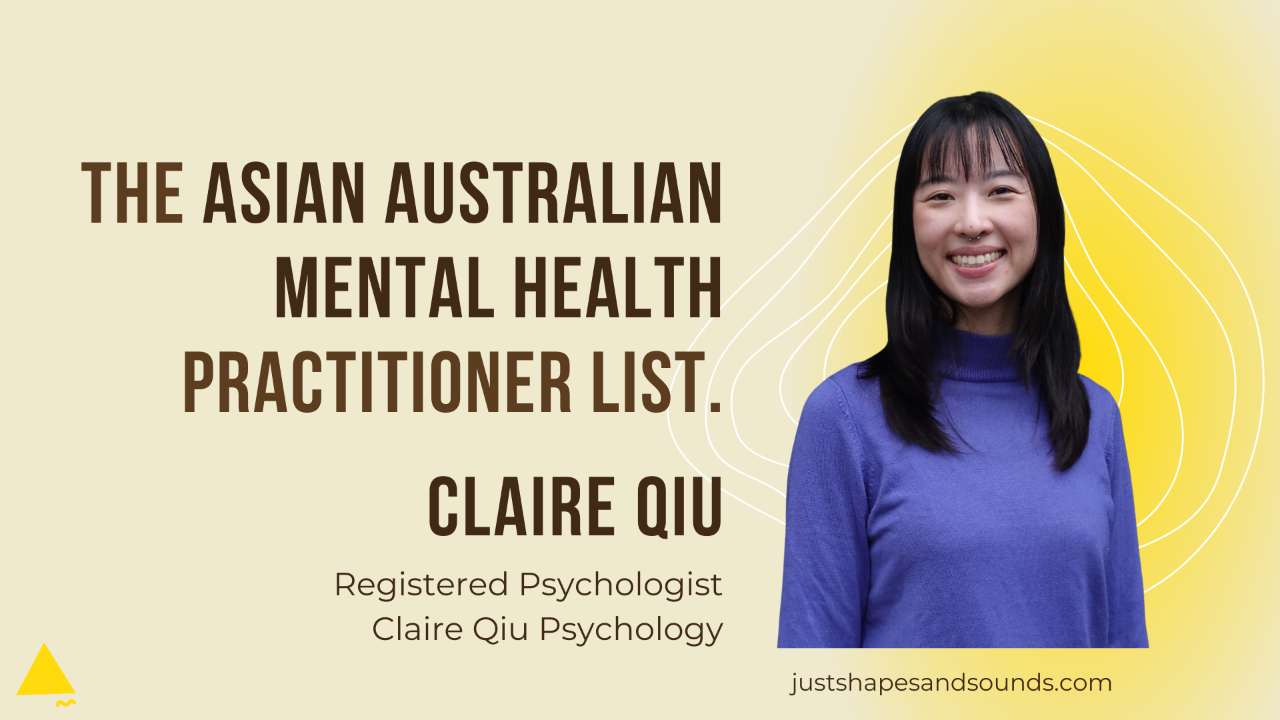
We know that it's not always easy trying to work out which therapist we might like to work with: Because the decision isn't just about where they're located and when they're available, but there's a bit more of a human, relational element to the decision too.
So here at Shapes and Sounds, we want to help make that process just a little easier.
Every month, we'll be introducing a therapist from the Asian Australian Mental Health Practitioner List to help you gain a bit more insight into who you feel might be a good fit for you or someone that you know.
This month we're excited to connect you with Claire who is a registered psychologist offering services in Glebe, NSW. We hope you enjoy connecting with Claire below!
~
1. What led you to choosing mental health as a career?
Growing up in an Asian household, I felt an intense stigma around mental health. I wanted to rebel against this stigma, as I saw how important it was. I could also see the devastating impact of intergenerational trauma (and how no one acknowledged it!) and wanted to do something to address it.
I’ve also always been fascinated by why people think the way they do and how differently everyone experiences reality. In particular, I was interested in how certain experiences, especially at critical points in early life can shape a person’s personality and impact their problems later on in adulthood.
My Clinical psychology Masters program was nothing short of transformational. I felt that I finally had a language to describe what I and many other children of Asian immigrants had gone through. Applying this language, I could see the power of psychotherapy to change and transform people’s lives. It is a privilege to walk beside people during their lowest periods, and so rewarding to see them become more expressive, less burdened by symptoms, and live life more fully, in a way that feels right for them.
2. What is your unique cultural heritage?
I am Australian-born Chinese and a second generation immigrant. I have lived experience of straddling these two major parts of my cultural identity and understand the challenges that come with it. I know what it is like to be a child of an immigrant population that was in survival mode in a foreign country, worked hard to provide for physical and material needs, and had certain expectations for their children. As a result of my dual cultural identity, I am always looking for ways to adapt psychological therapies that have been developed by Western therapists for Western clients, to an Asian population.
3. What are your areas of specialty and what kind of frameworks do you work from?
In addition to anxiety and long-standing mood issues, my area of specialty is interpersonal difficulties, which I work with from a relational and attachment-based framework. This broad category can show up in different ways. Apart from obvious signs of difficulties such as conflict or lack of intimacy in romantic relationships, it could also look like juggling family dynamics, constant people-pleasing in friendships, difficulties asserting what you want, and feeling alone despite having people around you. This area also extends to the relationship that you have with yourself. For example, you might feel that you sabotage yourself when working towards your goals, that you aren’t living to your full potential, that you don’t know who you are, feel worthless or undeserving, or experience inner conflicts and turmoil that are hard to put into words.
I am also a Circle of Security parenting program facilitator, which helps me to support parents who may be struggling to understand their child’s needs. This framework has helped me to understand and put into words the difficulties that people from an Asian background may have with parenting, in that they know what to do when it comes to their child’s physical needs, but feel lost when it comes to emotional needs. This framework has also helped me to understand adult clients who have not received secure parenting, and the consequences and grief that follow as they grow up.
4. What kind of clients are you best able to support?
I would say that anyone who wants to understand themselves better as a person, the relationships in their lives and their history and/or the impact that early events have had on their current struggles. Although I may draw from structured approaches such as CBT and DBT from time to time depending on what my clients needs, I focus on building insight and awareness of difficulties. Often, I find that once people are aware of vicious cycles they are trapped in, they often come up with their own solutions. I find that my approach is an especially good fit with people are looking for something in addition to strategies and skillbuilding. In any case, clients do not have to know exactly what they need help with to reach out for my help – it’s all part of the process.
As I have worked in complex community mental health, I have worked with clients on a spectrum from those with severe conditions to those who experience general dissatisfaction in life but would not meet any diagnostic criteria. Whether or not clients have a diagnosis/diagnoses, I tailor my interventions to suit their needs.
5. If you could be your own therapist right now, what do you think you would say to yourself?
The only constant in life is change. When facing the inevitable challenges of life, draw upon the strength from within yourself and the people around you, and put one foot in front of the other.
~
Connect with Claire via our Asian Australian Mental Health Practitioner List HERE.
Alternatively, if you feel like Claire may be a good fit for someone that you know, be sure to forward this page on to them too. Let us continue to not only support ourselves but all those around us too!
If you require urgent assistance, please do not contact Claire or any of the practitioners on this list. Instead, please call emergency services on 000 or call Lifeline on 13 11 14.
Shapes and Sounds does not recommend or endorse Claire or any of the practitioners listed on the Asian Australian Mental Health Practitioner List.
Please always consult your GP before making changes to your mental health care plan.
💡For community members:
We created the "Essential Guide for Asian Australian Mental Health" by surveying over 350 Asian Australians during Covid-19 lockdowns.
Download our guide and learn about the three most pertinent areas of concern for the Asian community, with tips and strategies to support you through.
🤝For mental health service providers:
Shapes and Sounds supports mental health organisations and teams to feel confident and resourced in providing culturally-responsive care to the Asian community in Australia.
Download our information pack to learn more.