
Meet Asian Australian Clinical Psychologist, Jen Puth
Oct 27, 2026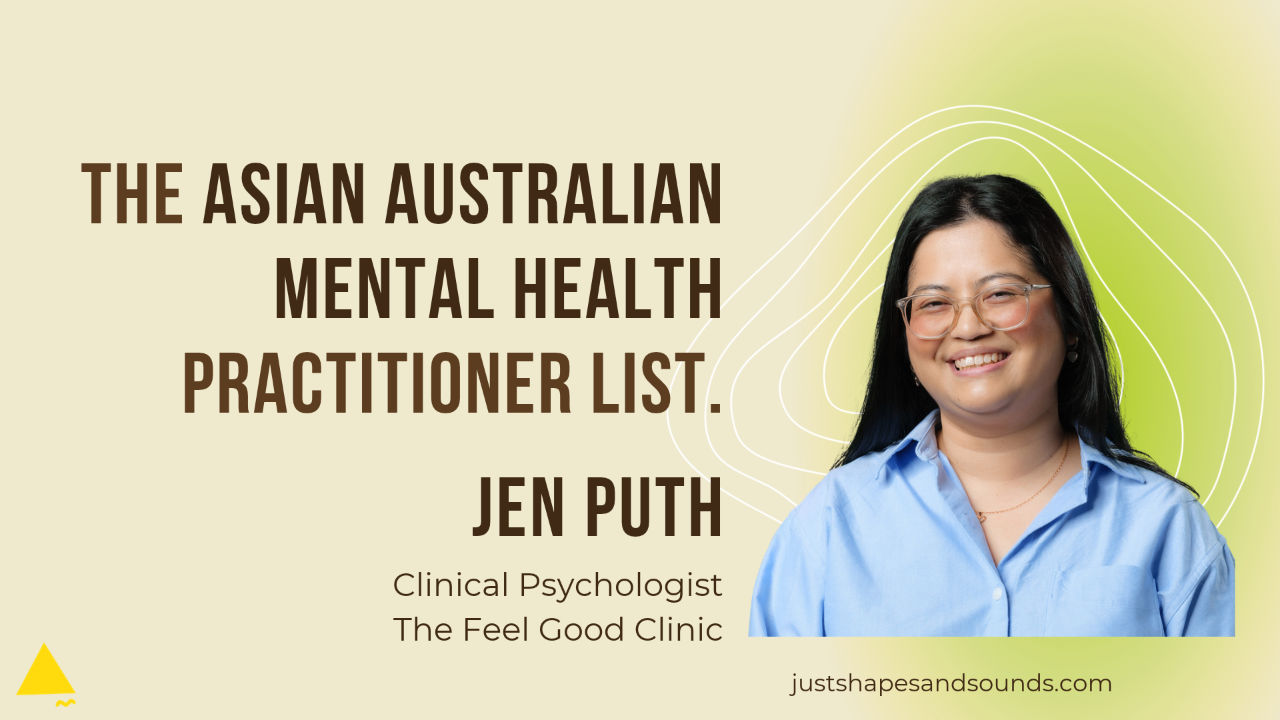
We know that it's not always easy trying to work out which therapist we might like to work with: Because the decision isn't just about where they're located and when they're available, but there's a bit more of a human, relational element to the decision too.
So here at Shapes and Sounds, we want to help make that process just a little easier.
Every month, we'll be introducing a therapist from the Asian Australian Mental Health Practitioner List to help you gain a bit more insight into who you feel might be a good fit for you or someone that you know.
This month we're excited to connect you with Jen who is a clinical psychologist offering services in Surry Hills, NSW and Telehealth. We hope you enjoy connecting with Jen below!
~
1. What led you to choosing mental health as a career?
At Macquarie University, we had a unique program where we were encouraged to take what were called People and Planet units. It gave us the opportunity to explore subjects outside of our core degree, so I chose to study sociology, gender studies and psychology. I initially leaned towards sociology and gender studies because I was interested in understanding how society is structured and the factors that contribute to inequality. Then, when I took psychology, I discovered a field that aligned with me and inspired me to pursue a career in mental health. One of my favourite units that I loved was psychopathology. It wasn’t just learning about different diagnoses (and how to differentiate between them) but rather the process of understanding how symptoms fit together and thinking critically about what might be contributing to an individual's presentation. That interest has stayed with me throughout my career, and diagnostic assessment is still one of the aspects of my work that I enjoy the most.
2. What is your unique cultural heritage?
Cambodian Australian
3. What are your areas of specialty and what kind of frameworks do you work from?
I thoroughly enjoy working with people across a range of presentations, particularly eating disorders, body image concerns, LGBTQIA+ related experiences, neurodivergence, trauma, depression and anxiety. I also value working with culturally diverse backgrounds, particularly in understanding the intersection between identity, culture and mental health. My clinical masters dissertation explored how lesbian women of colour navigate and cope with discrimination within an Australian context. It highlighted for me how important it is to consider the whole person. That is, one's culture, identity, relationships and lived experiences rather than viewing mental health difficulties separately from the context they occur in.
In my practice, I draw from evidence based approaches including Cognitive Behaviour Therapy (CBT), Acceptance and Commitment Therapy (ACT), Dialectical Behaviour Therapy (DBT), and Schema Therapy. I have also completed training in Maudsley Family Based Therapy (MFBT) and Specialist Supportive Clinical Management (SSCM) for eating disorders.
4. What kind of clients are you best able to support?
I think I work best with clients who are open to exploring their experiences with curiosity and who benefit from a warmth, collaborative, non judgemental and strengths based approach. I enjoy supporting people develop insight, build self compassion, and make meaningful changes aligned with their values. At the same time, I acknowledge that every client is different, and I approach each individual with curiosity. My aim is to meet clients where they are and to individualise their supports based on their needs.
5. If you could be your own therapist right now, what do you think you would say to yourself?
When I experience big emotions, I try to approach myself with the same compassion and curiosity that I would offer a client. I remind myself that emotions are not something to be feared or judged but rather they are information that can help us understand what matters to us and what we might need.
Instead of being mean or judging myself for feeling a particular way, I try to lean into compassion, such as "this is a difficult moment, and it makes sense that I’m feeling this way.” I find that creating space for emotions allows me to respond more intentionally rather than reacting from a place of overwhelm.
~
Connect with Jen via our Asian Australian Mental Health Practitioner List HERE.
Alternatively, if you feel like Jen may be a good fit for someone that you know, be sure to forward this page on to them too. Let us continue to not only support ourselves but all those around us too!
If you require urgent assistance, please do not contact Jen or any of the practitioners on this list. Instead, please call emergency services on 000 or call Lifeline on 13 11 14.
Shapes and Sounds does not recommend or endorse Jen or any of the practitioners listed on the Asian Australian Mental Health Practitioner List.
Please always consult your GP before making changes to your mental health care plan.
💡For community members:
We created the "Essential Guide for Asian Australian Mental Health" by surveying over 350 Asian Australians during Covid-19 lockdowns.
Download our guide and learn about the three most pertinent areas of concern for the Asian community, with tips and strategies to support you through.
🤝For mental health service providers:
Shapes and Sounds supports mental health organisations and teams to feel confident and resourced in providing culturally-responsive care to the Asian community in Australia.
Download our information pack to learn more.