
Meet Asian Australian Registered Psychologist, Yixuan Li
Jan 01, 2026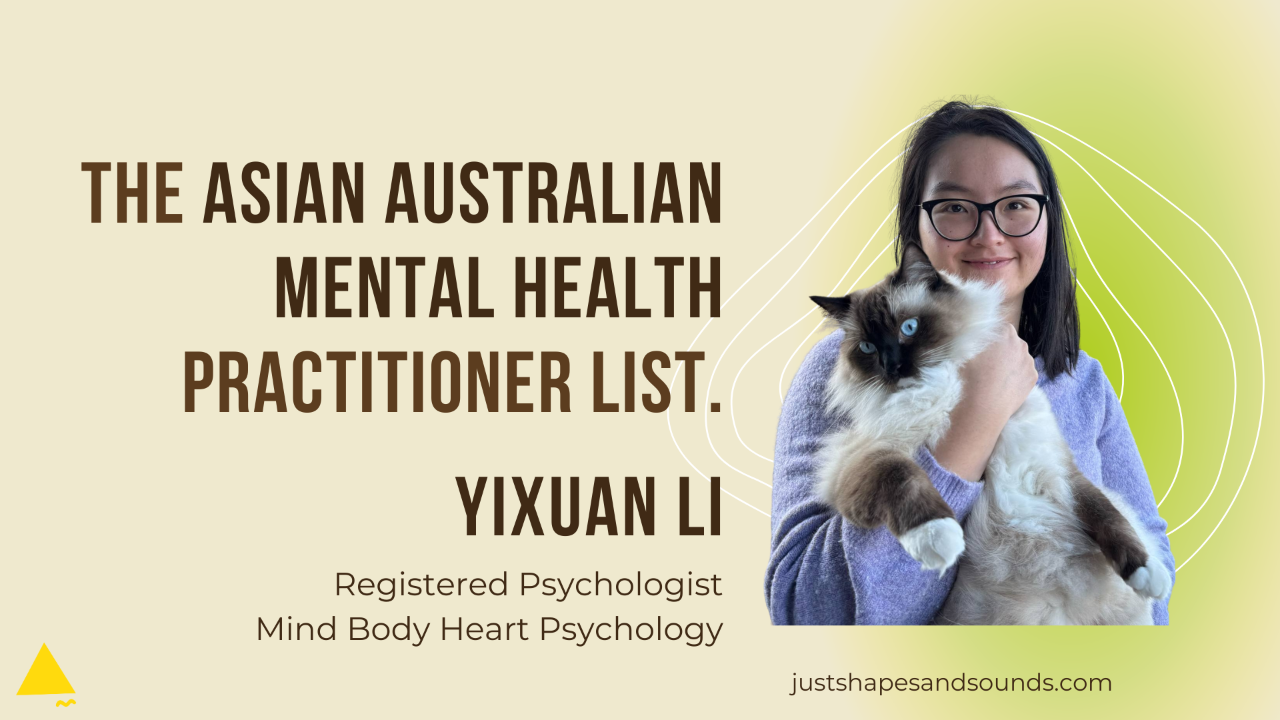
We know that it's not always easy trying to work out which therapist we might like to work with: Because the decision isn't just about where they're located and when they're available, but there's a bit more of a human, relational element to the decision too.
So here at Shapes and Sounds, we want to help make that process just a little easier.
Every month, we'll be introducing a therapist from the Asian Australian Mental Health Practitioner List to help you gain a bit more insight into who you feel might be a good fit for you or someone that you know.
This month we're excited to connect you with Yixuan Li who is a Registered Psychologist offering services in South Yarra and Blackburn, VIC We hope you enjoy connecting with Yixuan below!
~
1. What led you to choosing mental health as a career?
I've always been naturally curious about how people work — why we think, feel, and act the way we do, and how we relate to one another. Growing up in a family where several members worked in healthcare, I was often exposed to stories of trauma, loss, and grief. Seeing the emotional pain that people go through, especially in moments of losing a loved one, made me want to be someone who could offer support. I’ve found that what I truly enjoy is walking alongside people during difficult times — not to direct or fix them, but to hold space for their feelings and let them know they’re not alone.
2. What is your unique cultural heritage?
I moved to Australia when I was 17, and before that, I never really questioned my cultural identity. But after nearly a decade here, I’ve become much more reflective about who I am. I often notice how culturally Chinese I feel when I'm with my Australian partner — our ways of expressing emotion, communicating, or handling conflict can feel quite different. But when I return to China, my mum tells me I’ve become too direct or blunt. So sometimes I feel caught in-between cultures — not fully one or the other.
That said, I feel incredibly privileged to have had the opportunity to live across two cultures. It’s challenged many of the ideas I used to hold about what’s “right” or “normal,” and helped me question assumptions — like whether one should sacrifice personal happiness for family, or how to be assertive while still respecting others. I’ve come to see culture as something that shapes me, but doesn’t have to define or limit me. I can choose what resonates and build my own values from that.
In my work, this bicultural experience helps me stay open and curious. I understand that people’s thoughts, emotions, and behaviours make sense within the context of their lived experiences — even if others might label them as "problematic." I try to hold space for those experiences with compassion and flexibility, knowing that many struggles come from the tension between survival strategies and current challenges.
3. What are your areas of specialty and what kind of frameworks do you work from?
I work primarily with clients who have experienced trauma and with neurodivergent individuals. I genuinely enjoy working with people from neurodivergent communities — I’m often moved by the spark in their eyes and the passion they bring to the things they care about. I try to hold space for their strengths and hope that, with the right support and environment, they can thrive in a way that truly honours who they are.
I also feel deeply connected to clients who experience anxiety, perhaps because I’ve struggled with anxiety myself. In fact, they often remind me of one of my cats — she's always on high alert, scanning for danger, and I can see how her anxiety helps her survive, but also how it sometimes limits her well-being. Similarly, I work with clients to gently acknowledge and understand their anxious feelings without trying to fight them — and to still move toward what matters most in their lives.
Therapeutically, I’m grounded in Acceptance and Commitment Therapy (ACT) because of its emphasis on accepting emotions rather than struggling against them. I also draw from Internal Family Systems (IFS), which I deeply resonate with — the idea that all parts of us, even the ones that seem disruptive, are trying to help in their own way. I also use EMDR, particularly with trauma work, and appreciate how it honours the client’s inner capacity for healing. Across all approaches, my goal is never to "fix" people, but to walk beside them through their healing process, trusting in their innate strength to grow and recover.
4. What kind of clients are you best able to support?
I’ve worked with clients aged 7+, but I feel particularly connected to international students and neurodivergent individuals. As someone who has personally experienced the challenges of adjusting to life in a new country, I deeply understand the isolation, identity struggles, and emotional toll that can come with studying abroad. I also feel a strong sense of connection and admiration for neurodivergent clients — I value their unique ways of thinking and the rich inner worlds they bring to therapy.
I’m especially passionate about supporting individuals with a history of trauma. I strive to offer a warm and steady presence, and I take care to work at a pace that respects the client’s safety, readiness, and autonomy.
5. If you could be your own therapist right now, what do you think you would say to yourself?
I would tell myself: You are loved — by every part of you. The anxious part that sometimes makes you feel nauseous. The critical part that pushes you to do more and be more. They’re all here for a reason, and they all want what’s best for you. Even your body—even in moments when you struggle to love it—has stayed with you, carrying you through both physical and emotional hardship.
When it feels like no one in the world loves you, I want you to remember that your parts and your body still do. They’re always here with you, unconditionally.
I’d also gently remind myself that it’s okay to be exactly who I am — that love doesn’t have to be earned through perfection or productivity. And when I find myself stuck in anxious thoughts about the future, or when the present feels flat and joyless, I want to remind myself that the only thing that truly exists is now. That the people — and animals — I love, like my cat, are here with me now. And this moment is worth treasuring, simply because it won’t last forever.
~
Connect with Yixuan via our Asian Australian Mental Health Practitioner List HERE.
Alternatively, if you feel like Yixuan may be a good fit for someone that you know, be sure to forward this page on to them too. Let us continue to not only support ourselves but all those around us too!
If you require urgent assistance, please do not contact Yixuan or any of the practitioners on this list. Instead, please call emergency services on 000 or call Lifeline on 13 11 14.
Shapes and Sounds does not recommend or endorse Yixuan or any of the practitioners listed on the Asian Australian Mental Health Practitioner List.
Please always consult your GP before making changes to your mental health care plan.
💡For community members:
We created the "Essential Guide for Asian Australian Mental Health" by surveying over 350 Asian Australians during Covid-19 lockdowns.
Download our guide and learn about the three most pertinent areas of concern for the Asian community, with tips and strategies to support you through.
🤝For mental health service providers:
Shapes and Sounds supports mental health organisations and teams to feel confident and resourced in providing culturally-responsive care to the Asian community in Australia.
Download our information pack to learn more.