
"You Don't Have to Prove Yourself": Filipino-Chinese Psychology Student on Cultural Pride, Systemic Stigma, and Finding Yourself Far From Home
Jul 28, 2026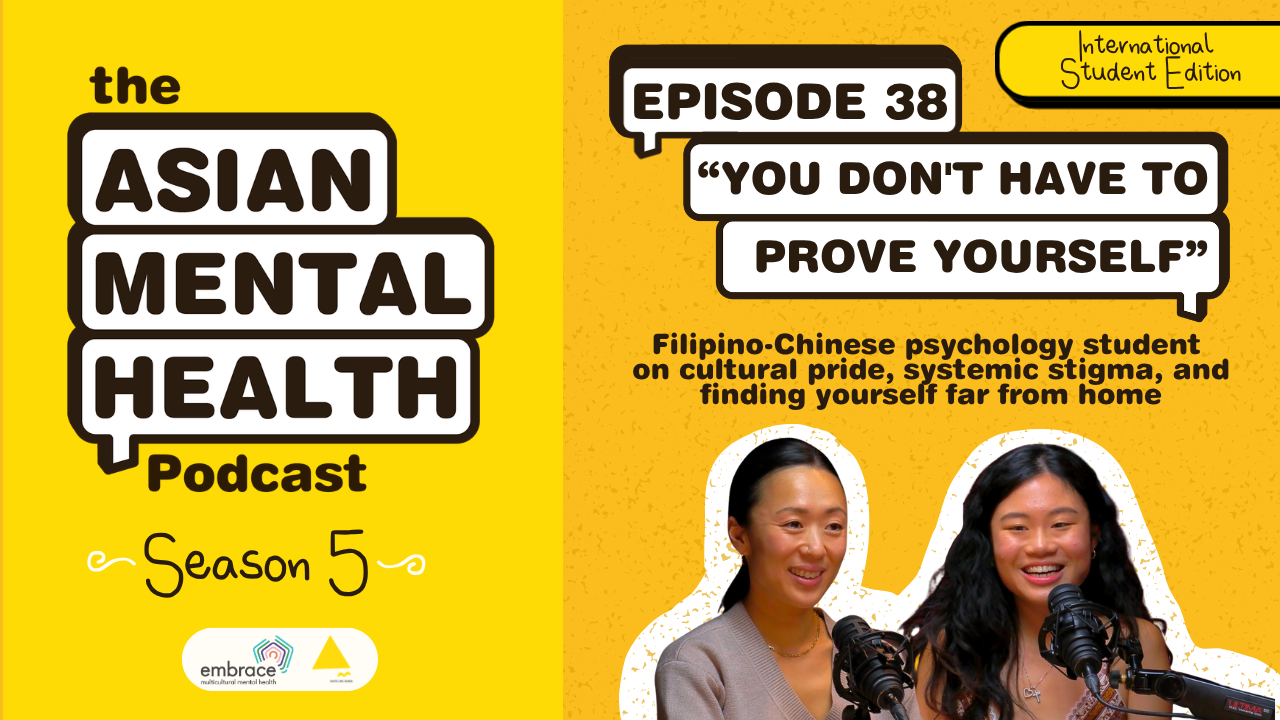
⚠️ Content warning: This episode includes mentions of eating disorders and depression. Please approach this carefully. If this doesn't feel right for you today, skip ahead or return when you're ready.
What happens when your culture is something you only truly discover after leaving it behind? In this episode, Asami sits down with Cait, a Filipino-Chinese undergraduate psychology student, youth mental health advocate, and owner of 11 dogs (!) each with their own personality and their own wanted-poster photo frame.
Cait moved from the Philippines to Melbourne to study psychology, carrying with her a history of depression, anxiety, and an eating disorder, none of which she disclosed when she arrived. "I had a clean slate," she says, "and it really backfired on me." What followed was a year and a half of navigating a new country, a fragmented mental health system, and the slow, surprising discovery of who she actually was as a Filipino, something she never had to think about back home.
In this conversation with Asami, Cait opens up about the Filipino concept of kakayanin (to endure), how colonialism has shaped the way Filipinos understand mental health, why a diagnosis in the Philippines can feel more like a kryptonite than a lifeline, and what it means to fight for culturally grounded mental health research. This one is warm, funny, and deeply honest, and it's the kind of conversation that reminds you why representation in mental health spaces is a non-negotiable, not a "nice to have".
Watch the episode below or find us on Spotify or Apple Podcasts!
🎧 You'll hear about:
✅ Growing up Filipino-Chinese and falling short of academic expectations
✅ Depression and navigating stigmatised mental health services in the Philippines
✅ Moving to Australia and leaving your mental health history behind, and why that backfired
✅ Kakayanin: the Filipino concept of endurance and its double edge
✅ Why Filipinos telling stories through karaoke might actually be the research gap we need
💡 Episode Highlights:
- On Filipino food and belonging: "I never realised how special it was to be eating Filipino food around Filipinos until I was removed from it, and then I realised what was missing"
- On cultural pride: "We are very empathetic to the extent that sometimes it's not always good, because it borders to judgment or being able to read the room too much"
- On kakayanin and toxic resilience: "Is this built up a culture of toxic resilience? That kind of expression of kakayanin is built and constructed by a lot of these external forces, even if it's not suitable for our mental health"
- On her depression diagnosis in the Philippines: "I realised, because I had depression, because I was failing classes, I wouldn't thrive anywhere. Even if I were getting better, my past has shaped where I am now"
- On mental health systems failing young people: "These systems failed me continuously growing up. I'm just lucky that I had people who genuinely loved me to be able to fight through that"
- On the research gap: "Mental health in a Western context is this optimal way of living. But the conversations I had with a lot of Filipinos is how to cope and to be resilient in everyday life, just surviving my day, that's mental health for me"
- On being seen: "Your identity is something that's so valuable. You might feel pressured to assimilate and become invisible, but that's not who you are"
🧠 Key Takeaways from Cait:
"You don't have to feel like you have to prove yourself. What's important is that you love yourself first, and that love only grows when you're kind to yourself."
"Culture is not this exotic, amazing thing from the East that's gonna heal you. It's really complex. It also carries a lot of distress."
"I wish Filipinos thought of mental health problems as an experience that some people really do go through, and we need to be holding their hands through it."
"I'm just a drop in the bucket, but if I even make that drop, these conversations are not going to be happening otherwise."
"A fish doesn't understand the concept of water. Once you're removed from your home culture, you're like, oh, this is what I've been missing."
"Don't be afraid to show these aspects of yourself. Who you are is a constellation of your past, your present, and your continuing."
👤 About the Guest
Cait is a Filipino-Chinese undergraduate psychology student in Melbourne and a passionate advocate for youth mental health, particularly within Filipino communities. As a participant in the Shapes and Sounds Student Changemakers program, Cait carries both her own lived experience with depression, anxiety, and navigating cultural stigma, and the stories of other young Filipinos she has spoken with along the way. She is deeply invested in reshaping how mental health is understood and researched across Southeast Asian contexts, and believes those conversations start over food, language, and karaoke.
🔗 Find culturally responsive practitioners on the Asian Mental Health Practitioner List HERE
💡As a bonus, connect with Arthur De Jesus who's a Filipino clinical psychologist and the founder of AK Psychology, Melbourne's first Filipino psychology private practice!
🛠️ Resources Mentioned:
Cultural Concepts:
- Kakayanin: Filipino concept meaning "to endure, to keep going in spite of"; can be a source of strength and toxic resilience
- Gaman: Japanese concept of enduring hardship with dignity and without complaint; discussed in parallel
Mental Health Support:
- University counselling services: free, confidential, does not appear on academic transcripts
- OSHC (Overseas Student Health Cover): provides partial rebates for psychology sessions
Self-Care Practices Cait Swears By:
- Compassionate self-talk: physically telling yourself "stop" when catastrophising begins
- Prayer and handing it over to a higher purpose
- Reaching out to a friend, after you've checked in with yourself first
- Blowing bubbles (a simple way to encourage deep, calming breaths)
- Filipino food and community potlucks
🙌 Connect with Shapes and Sounds
🎁 Free Resource: Download "International Students and Mental Health"
~
Do you work with international students? If so, you may be interested in learning more about the Student Changemakers program as well as downloading our project summary report HERE.
~
✨ If this episode resonated with you, please subscribe, rate, and review the Asian Mental Health Podcast on your favourite podcast app. It really helps other international students find these conversations. Share this episode with your friends, especially if you know, or are, a young Filipino navigating life far from home. Word of mouth is how we destigmatise mental health in Asian communities. 💛
The Asian Mental Health Podcast is a production from Shapes and Sounds, made on the stolen lands of the Wurundjeri Woi-wurrung people of the Kulin Nation. This show is hosted by Asami Koike and Marcus Lai and produced by Yeo Choong. This season is brought to you by Embrace Multicultural Mental Health. All thoughts and ideas you hear are independently ours and our guests.
💡For community members:
We created the "Essential Guide for Asian Australian Mental Health" by surveying over 350 Asian Australians during Covid-19 lockdowns.
Download our guide and learn about the three most pertinent areas of concern for the Asian community, with tips and strategies to support you through.
🤝For mental health service providers:
Shapes and Sounds supports mental health organisations and teams to feel confident and resourced in providing culturally-responsive care to the Asian community in Australia.
Download our information pack to learn more.