
April Organisational Newsletter: Our new website!
Apr 01, 2026
April: Our new website!
Hello there,
We have a brand new website which I'm excited to finally be sharing with you today!
As our Asian Mental Health Practitioner List grew to over 100+ practitioners early last year, we knew that we had to upgrade our website to make it easier to search for a therapist.
Please find the new and improved Asian Mental Health Practitioner List HERE.
This is a list of private practitioners who are passionate about and committed to supporting the needs of Asian community members. They also all have access to quarterly CPD sessions with us to stay up to date with the emerging literature in culturally-responsive practice.
Please consider using this list as an external referral pathway and/or, share this as a resource for those in your network to access in their own search for a therapist.
The website is still finding its feet so if you find any glitches or can't find what you're looking for, please reach out to me by email at hello @ justshapesandsounds.com .
Thank you for your ongoing support :)
Cheers,
Asami
🌱 Important dates and festivals this month
Some important cultural festival and dates this month include:
April 1: Mesha Sankranti / Vaisakhi. This solar New Year is celebrated across India and Nepal. For Sikhs, Vaisakhi commemorates the formation of the Khalsa panth of warriors, marked by colorful processions (Nagar Kirtan) and community service. For Hindus, it marks the start of the solar harvest season.
April 13–15: Songkran (Thai New Year). Known as the water festival, Songkran is celebrated in Thailand by cleaning Buddha images and splashing water on others to symbolize purification and the washing away of bad luck. It is a time for family reunions and visiting temples to make merit.
April 14: Khmer New Year (Chaul Chnam Thmey). Celebrated in Cambodia, this festival marks the end of the harvesting season. Families gather to play traditional games, decorate their homes with altars, and visit pagodas to offer food and receive blessings from monks.
April 14: Thingyan (Burmese Water Festival). This is the Burmese New Year festival. Like Songkran, it involves widespread water-throwing to cleanse the sins of the past year. It is also a period of deep religious observance, with many people spending time at monasteries.
April 14: Pohela Boishakh (Bengali New Year). Celebrated in Bangladesh and West Bengal (India) with vibrant street processions called Mangal Shobhajatra. It is a day of cultural pride, featuring traditional music, dance, and the opening of new accounting books (Haal Khata) by traders.
April 14: Puthandu (Tamil New Year). Observed by Tamil communities in India, Sri Lanka, Malaysia, and Singapore. Families decorate their entrances with colorful rice-powder designs (Kolam) and prepare 'Mangai-Pachadi', a dish combining sweet, sour, and bitter tastes to symbolize the varied experiences of life.
April 14: Vishu. The New Year festival in Kerala, India. It is centered on the 'Vishukkani'—a ritual arrangement of auspicious items (gold, fruits, flowers) that is the first thing one sees upon waking to ensure a prosperous year ahead.
April 14: Aluth Avurudda (Sinhalese New Year). Celebrated by the Sinhalese people in Sri Lanka alongside the Tamil New Year. It is marked by traditional rituals performed at specific "astrologically auspicious" times, including lighting the hearth and the first meal of the year.
How will your organisation be marking these important dates this month? Feel free to reach out to us if you'd like some ideas!
🦉 Research perspectives to strengthen your culturally-responsive practice:
Within a recent review by Chatwiriyaphong et al. (2025), the authors found that South East Asian health professionals (doctors, social workers, psychologists), and health students (medical, nursing, OT), often characterised mental health recovery through symptom reduction and medication adherence. This medical approach to mental health, whilst has some merits, may also lead to the overlooking of individual and holistic factors of mental wellbeing. This can also lead to the neglecting of lived experiences of mental health throughout recovery, as health professionals become preoccupied with symptom reduction only.
What does this mean for clinicians and the community?
Recovery-oriented care that focuses on understanding the sociocultural context of mental wellbeing is crucial to promoting positive adjustment for those currently experiencing mental ill-health. Whilst it is important to be aware of clinical recovery, personal recovery journeys (e.g., life satisfaction) should also be prioritised. Centring lived experience voices within mental health training and programs is also crucial in promoting more responsive, person-centred, care.
Reflective prompt:
Considering the primary finding that mental health recovery in Southeast Asia is often conceptualised as a "medically-driven and determined return to normal functioning", how does your own professional practice balance the goals of clinical recovery (symptom reduction and functional improvement) with the principles of personal recovery (lived experience, hope, meaning, adjustment, and self-direction)?
You're welcome to reach out to us by replying to this email, if you'd like some perspective on this.
💡Our new recorded training is live.
The new professional standards for psychologists have been established and a core element of this shift is to embed cultural competency throughout all aspects of practice. As the leading voice for Asian mental health in Australia, we can support you to meet these requirements in regards to the largest culturally diverse community in Australia.
After supporting organisations like headspace Syndal and Elsternwick, Monash Youth Services and The Australasian Genetic Counsellors Society in 2025, we have now launched a recorded version of our train our core training for you to begin right now.
Ready to learn more? Click the link here!
🔎 Connect with our new therapists.
Our Asian Australian mental health practitioner list introduces you to private practitioners who are skilled in supporting the Asian community's mental health needs.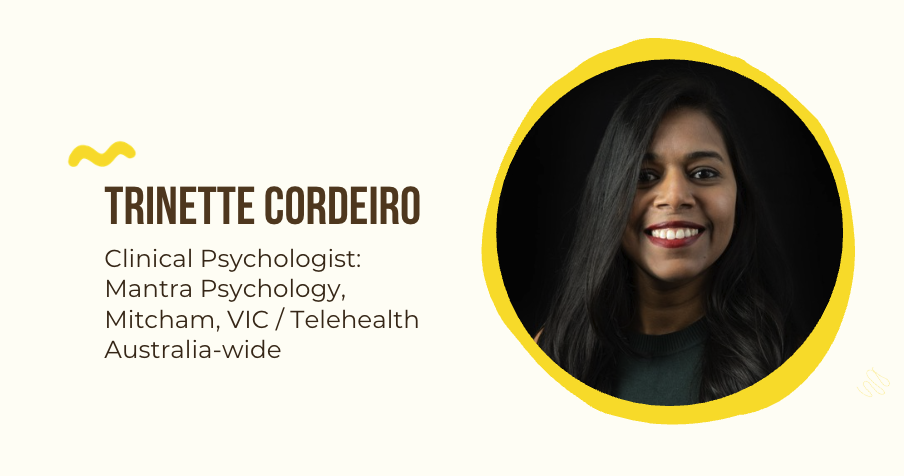
Our private practitioners are available for referrals. Please contact them directly via their profile HERE.
✨Exciting Job Opportunity✨
Calling all CALD clinicians who speak both English and Mandarin: there's an incredible part-time opportunity available at headspace Syndal.
I've worked closely with hSyndal since October 2024 and I've loved the team's commitment to culturally-responsive practice and providing relevant care to the multicultural communities in this area.
Please see the Position Description and reach out to the clinical lead Rachel Lim (rac.lim@alfred.org.au) to express your interest asap.
🐌 And last but not least:
Recently on Linkedin,
We shared our practitioner interview with counsellor Devika Dey. Read our interview with her here.
💡For community members:
We created the "Essential Guide for Asian Australian Mental Health" by surveying over 350 Asian Australians during Covid-19 lockdowns.
Download our guide and learn about the three most pertinent areas of concern for the Asian community, with tips and strategies to support you through.
🤝For mental health service providers:
Shapes and Sounds supports mental health organisations and teams to feel confident and resourced in providing culturally-responsive care to the Asian community in Australia.
Download our information pack to learn more.