
July Organisational Newsletter
Jul 01, 2026
July: Seeing strengths, not just challenges
Hello there,
Over the past month, I've had the opportunity to continue deepening our work with international students alongside Study Melbourne, as well as migrant parents with the wellbeing team at the Mac.Robertson Girls' High School.
While the contexts were different, one message felt deeply consistent.
When we work with diverse or migrant communities, it's evident that people want their challenges recognised, but they also want their strengths recognised.
Migration is known to be one of the most stressful experiences a person can go through: Migrant parents raising high-performing, second-generation children face unique challenges. International students who continually support their friends through distress hold fear and worry, constantly.
Yet many of these people that we have the privilege of meeting, continually demonstrate extraordinary resilience and resourcefulness every day.
When services start by first celebrating the ways parents are already supporting their children, or the ways students are already supporting one another, you can feel something shift in the room.
People feel seen rather than assessed. They feel understood rather than simply defined by risk.
For those of us working in mental health, community services and education, this has been an important reminder. A strengths-based approach isn't about ignoring challenges but it has to be about deeply recognising the capabilities that already exist alongside these migrant communities.
If you're interested in learning more about what international students told us directly about engagement, mental health and support, we've recently published our Student Changemakers project report, which is available to download here.
Thank you for continuing to do the important work of supporting our communities.
Cheers,
Asami
🌱 Important dates and festivals this month
Some important cultural festival and dates this month include:
July 5–12: NAIDOC Week. An important celebration across Australia honoring the history, culture, and achievements of Aboriginal and Torres Strait Islander peoples. It is observed by all Australians through community events and cultural performances.
July 21: Asalha Puja (Dhamma Day). A major Buddhist festival commemorating the Buddha's very first sermon after attaining enlightenment. It is traditionally observed with temple visits, chanting, and meditating on his core teachings.
How will your organisation be marking these important dates this month? Feel free to reach out to us if you'd like some ideas!
🦉 Research perspectives to strengthen your culturally-responsive practice:
A recent study by Qiu et al. (2025) compared Australian and Malaysian trauma survivors to investigate how culture influences the role of social support in PTSD recovery. Findings showed that relationship conflicts exacerbated symptoms more for Malaysians, while communal orientation (one's inclination to support others) uniquely aided the recovery of Malaysian. Conversely, perceived support availability significantly reduced distress only for Australians.
What does this mean for clinicians and the community?
Clinicians should move beyond Western-centric understandings of PTSD to provide culturally tailored care. For some, recovery may involve conflict resolution and community contribution rather than just seeking explicit help and emotional disclosure.
Reflective prompt:
In your eyes, what role does social support play in trauma recovery? Have you noticed any cultural differences in how social support impacts recovery outcomes within therapy? How might you sensitively probe the unique role of social support in your client's lives?
You're welcome to reach out to us by replying to this email, if you'd like some perspective on this.
💡Our new recorded training is live.
The new professional standards for psychologists have been established and a core element of this shift is to embed cultural competency throughout all aspects of practice. As the leading voice for Asian mental health in Australia, we can support you to meet these requirements in regards to the largest culturally diverse community in Australia.
After supporting organisations like headspace Syndal and Elsternwick, Monash Youth Services and The Australasian Genetic Counsellors Society in 2025, we have now launched a recorded version of our train our core training for you to begin right now.
Ready to learn more? Click the link here!
🔎 Connect with our new therapists.
Our Asian Australian mental health practitioner list introduces you to private practitioners who are skilled in supporting the Asian community's mental health needs.
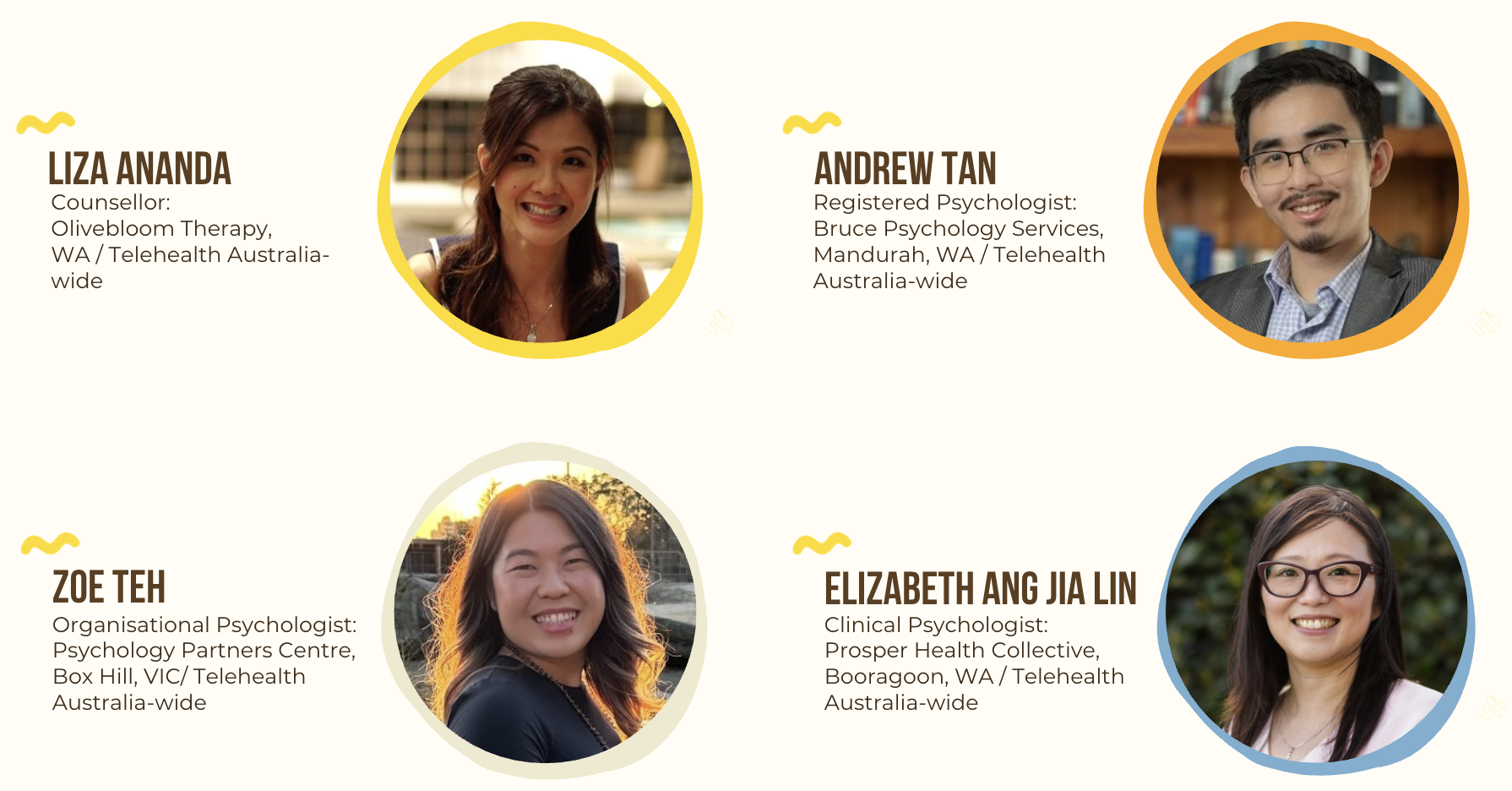
Our private practitioners are available for referrals. Please contact them directly via their profile HERE.
🐌 And last but not least:
Recently on Linkedin,
We shared our practitioner interview with clinical psychologist Pallavi Pillay and counsellor Gabriella Gandi. Read our interviews with them HERE and HERE.
💡For community members:
We created the "Essential Guide for Asian Australian Mental Health" by surveying over 350 Asian Australians during Covid-19 lockdowns.
Download our guide and learn about the three most pertinent areas of concern for the Asian community, with tips and strategies to support you through.
🤝For mental health service providers:
Shapes and Sounds supports mental health organisations and teams to feel confident and resourced in providing culturally-responsive care to the Asian community in Australia.
Download our information pack to learn more.