
June Organisational Newsletter: Sharing community feedback
Jun 01, 2026
June: What international students want services to understand
Hello there,
On June 16th, we'll be launching Season 5 of the Asian Mental Health Podcast in partnership with Embrace Multicultural Mental Health as part of their national suicide prevention pilot program.
This podcast season has been especially meaningful for our team, as it has created an opportunity to further amplify the voices and lived experiences of international students across Victoria.
Our recent focus groups with international students set the scene for this project and one repeated message has continued to stay with us: many students expressed wanting services and systems to better recognise their resilience, capability and strengths.
Of course, we recognise that services are often responding to very real and elevated levels of distress, isolation and systemic pressures experienced by international students. However, the feedback reminded us of the importance of being able to respond appropriately to risk while also reiterating and highlighting the courage, adaptability and resourcefulness that international students demonstrate every day as new migrants.
As always, we're grateful to continue learning from the communities we work alongside and look forward to sharing this new season with you soon. Please subscribe to the podcast here!
If you're looking for more resources to support your work with international students, please don't hesitate to reach out to us.
Cheers,
Asami
🌱 Important dates and festivals this month
Some important cultural festival and dates this month include:
June 19: Dragon Boat Festival. Celebrated across China and East Asia, this festival honors the poet Qu Yuan. It is famous for dragon boat racing and eating zongzi (sticky rice dumplings) to ward off evil and celebrate community strength.
June 19: Dano Festival. A major traditional holiday in Korea that marks the end of the spring planting season. It involves rituals to pray for a good harvest, traditional wrestling (Ssireum), and washing hair in water boiled with sweet flag (Changpo) to bring good luck.
How will your organisation be marking these important dates this month? Feel free to reach out to us if you'd like some ideas!
🦉 Research perspectives to strengthen your culturally-responsive practice:
Aiyar and colleagues (2025) explored the experiences of parenting among South and South East Asian migrant caregivers within their first 2000 days in Australia, and found that mothers often reported a disruption to their parental identity as they navigated cultural changes. These were often worsened by other stressors such as feeling overwhelmed by motherhood, difficulties with accessing and communicating with Western healthcare systems, and isolation. However, despite these challenges, many drew upon their internal courage, existing parenting skills, and religious faith to cope with these struggles.
What does this mean for clinicians and the community?
It is important to recognise that in addition to the addressing the demands of parenting, migrant parents are also faced with additional stressors relating to cultural changes, migration, and isolation. An intersectional lens which considers their unique experiences and stressors is key to providing culturally responsive, person centred care.
Reflective prompt:
What are some of the intersecting stressors you can think of for Asian migrant parents? How might your own cultural identity and professional training influence your interpretation of their experience?
You're welcome to reach out to us by replying to this email, if you'd like some perspective on this.
💡Our new recorded training is live.
The new professional standards for psychologists have been established and a core element of this shift is to embed cultural competency throughout all aspects of practice. As the leading voice for Asian mental health in Australia, we can support you to meet these requirements in regards to the largest culturally diverse community in Australia.
After supporting organisations like headspace Syndal and Elsternwick, Monash Youth Services and The Australasian Genetic Counsellors Society in 2025, we have now launched a recorded version of our train our core training for you to begin right now.
Ready to learn more? Click the link here!
🔎 Connect with our new therapists.
Our Asian Australian mental health practitioner list introduces you to private practitioners who are skilled in supporting the Asian community's mental health needs.
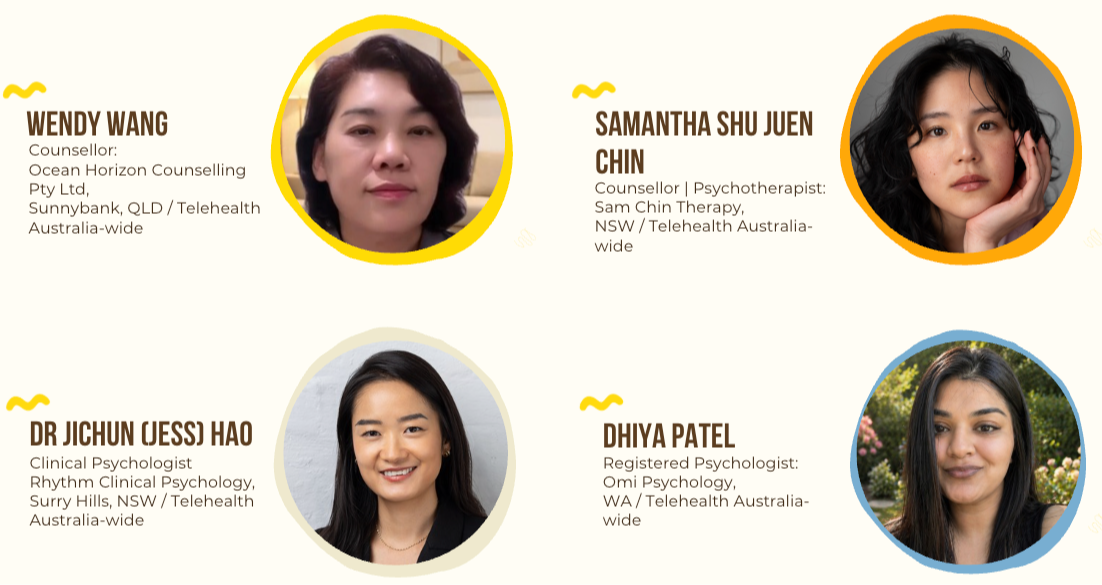
Our private practitioners are available for referrals. Please contact them directly via their profile HERE.
✨For Schema Therapists✨
Daniela Ho Tan is one of the practitioners on our Asian Mental Health Practitioner List and as part of her PhD, she's conducting a research study exploring the experiences of mental health practitioners who have provided or are currently providing schema therapy to people of Asian heritage.
The research is interested in understanding if and how cultural factors have been addressed in your experience of delivering schema therapy.
Taking part in this study is voluntary and the study has been approved by the Human Research Ethics Committee (HREC) of The University of Sydney [ethics reference: 2025HE001027].
Learn more and register HERE.
🐌 And last but not least:
Recently on Linkedin,
We shared our practitioner interview with clinical psychologist Helen Su and counsellor Aysu Kurucan. Read our interviews with them HERE and HERE.
💡For community members:
We created the "Essential Guide for Asian Australian Mental Health" by surveying over 350 Asian Australians during Covid-19 lockdowns.
Download our guide and learn about the three most pertinent areas of concern for the Asian community, with tips and strategies to support you through.
🤝For mental health service providers:
Shapes and Sounds supports mental health organisations and teams to feel confident and resourced in providing culturally-responsive care to the Asian community in Australia.
Download our information pack to learn more.